CaRMS Personal Letter Guide: How to Write a Standout Personal Statement
Table of contents
If you're a final-year Canadian medical student or an IMG (International Medical Graduate) staring at a blank CaRMS Online text box, here's the short version. A strong personal letter isn't one essay you write once. It's a letter you rewrite for each program, answering exactly what that program asked, in the length it allowed. This document is also commonly called a personal statement; both terms refer to the same application document. Get that right, and you improve your odds of an interview. Skip it, and you quietly hurt your chances. This guide covers how to write the letter, what evaluators actually look for, and the verified 2027 CaRMS dates you need to plan around.
Once your application is ready, use our CaRMS interview guide and top 10 CaRMS interview questions to prepare for the next stage.
What CaRMS actually asks for
Your personal letter is where you introduce yourself to a program and explain why you chose it. You may also see it described as a personal statement. CaRMS explains the document requirements for the R-1 application process.
CaRMS Online lets you use one personal letter for every program, or prepare a separate letter for each program or discipline. Most successful applicants choose the second option, because each program sets its own preferences for what the letter should cover. Some provide a broad prompt, while others give you specific questions and a strict word limit. A single generic letter rarely answers what was actually asked — and that idea, tailor it rather than reuse it, is the theme of this whole guide.
A CaRMS personal letter isn't one fixed essay. It's a template you adjust for every program that asks something different.
How personal letters are evaluated
The letter alone won't get you matched. But a weak one can cost you an interview. Here's some real data: a 2021 survey of Canadian anesthesia program directors asked what factors matter most when choosing who to interview. Out of 73 factors, clear career direction in the personal letter ranked 16th — well below things like elective performance and reference letters. That doesn't mean the letter is unimportant. It means the letter is a screening step, not your golden ticket.
One director in that survey said he distrusts letters that claim specific interest in his program, because most aren't honest. The lesson: vague flattery like "your world-class program" sounds generic and forgettable. Naming something real and specific — a particular clinic, a faculty member, a training stream — sounds genuine.
A separate study of program directors, published in ATS Scholar, found similar priorities. Directors want clear, well-written letters that add information not already found elsewhere in your file. More than half said the letter is at least somewhat important when deciding who gets an interview. One more note worth flagging: if English isn't your first language, get a second reader to check your letter for errors before you submit.
Canadian residency training is built around a framework called CanMEDS — seven roles like Communicator, Collaborator, and Leader. You don't need to name these roles in your letter. Just let a couple of them show up naturally through your stories.
Before you write: research each program's requirements
Do this before drafting a single sentence. Read every target program's listing in the CaRMS program directory and note:
- Whether a personal letter is required at all (a few programs skip it)
- The exact questions or prompts to answer
- The word or character limit
- Any specific "why this program/city" question
- Whether one letter covers every stream, or each stream needs its own
Requirements vary a lot. Some programs post detailed, multi-question prompts with a tight word count. Others just want three things about you in 150 words. If you miss the actual question, or go over the word limit, it signals you don't follow instructions — the opposite of what a program wants to see.
The applicants who match aren't the best writers. They're the ones who answered the actual question the program asked, in the length it allowed.
Structure of a strong personal letter
Once you know each program's requirements, don't start from zero every time — use a repeatable skeleton instead. Most Canadian career offices recommend roughly one page, single-spaced, addressed to the program director and selection committee. Structure: an opening, two body paragraphs, and a close. When programs specify a length, it's usually 500–750 words.
Here's a five-part structure — SPARC — you rebuild for each program:
| Letter section | What it should do | Poor version | Exceptional version |
|---|---|---|---|
| Story (hook) | Earn the reader's attention | "Medicine is a noble calling that I have always admired." | "At 3 a.m. on my first night on call, a patient's daughter asked me a question I couldn't answer — and I realized I wanted a career where I never stopped chasing that answer." |
| Path (why this field) | Show mature understanding of the specialty as a job | "I love helping people, so family medicine is perfect." | "The continuity — following a family across a decade rather than a single admission — is what pulled me toward family medicine." |
| Aptitude (experiences) | Prove your fit, don't just assert it | "I am a strong communicator and hard worker." | "Running the student clinic's intake line taught me to translate a frightened patient's story into a usable history under time pressure." |
| Rationale (why this program) | Show genuine, specific fit — rewrite every time | "Your world-renowned program would be an honour." | "Your rural longitudinal stream and the addictions clinic Dr. X leads match the practice I want to build in northern BC." |
| Close | Leave a believable, forward-looking impression | "I would be grateful for the opportunity." | "I want to train where I'll be pushed to lead a team early — your first-year (PGY-1) structure does exactly that." |
If you only improve one paragraph, make it Rationale. It's the one programs use to test whether you mean it.
Applying to more than one specialty? Keep Story and Aptitude fairly stable across letters, but rewrite Path and Rationale each time. A psychiatry letter and an orthopedics letter should read like they came from two deliberate, distinct decisions — not one letter with a few words swapped out.
Common mistakes to avoid
- Ignoring the prompt or word limit — the single most damaging error
- Reciting your CV instead of telling the story behind it
- Generic flattery ("your prestigious program")
- A clichéd opening line ("Since childhood, I've wanted to be a doctor")
- Typos and grammar slips — read it aloud, then have someone else read it
- Overclaiming — grand, unverifiable promises undercut credibility
- Starting too late — this needs multiple drafts and outside eyes
- Copy-paste errors — sending the wrong program's name when you're batch-editing many letters
For extra perspective: the CFMS maintains a residency and match support hub with its annual Matchbook, and the CMA's CaRMS Prep hub covers the wider match process.
Timeline: when to start writing
Use verified dates, not guesses. Here's the schedule for the 2027 R-1 Main Residency Match (first iteration) — the cycle current final-year students and IMGs are applying in now. These dates come from the official CaRMS applicant timeline:
| Milestone (2027 R-1, first iteration) | Date |
|---|---|
| CaRMS Online opens; program descriptions available | September 9, 2026 |
| Program selection opens | October 15, 2026 |
| Reference submission deadline | November 25, 2026 |
| Application & document deadline | November 26, 2026 |
| National interview period | January 16 – February 7, 2027 |
| Rank order list deadline | February 18, 2027 |
| Match Day | March 2, 2027 |
Working backward from the November 26 deadline:
- September: Pull every target program's description; build your requirements list; draft your master letter.
- Early-to-mid October: Write program-specific versions before document selection opens October 15.
- Late October–mid-November: Get feedback from a mentor who has reviewed CaRMS files, then revise.
- Before you assign: Final proofread aloud, checking the program name in every version.
Give yourself six to eight weeks. The stakes are real. In the 2026 R-1 Match, 87 current-year Canadian medical graduates — 2.9% of applicants — went unmatched after the second round of matching. That's up from 49 (1.6%) the year before. Every part of your application you can control is worth controlling.
Practice With ResidencyAI
Writing a personal letter, or personal statement, by yourself can be very daunting. ResidencyAI can review your personal statement, annotate it and suggest changes that will distinguish it from the crowd. Additionally, ResidencyAI will act as your personal interview coach, available, to help you practice and refine your answers.
Ready to practice your interview skills?
Try AI-powered mock interviews and get instant, actionable feedback.
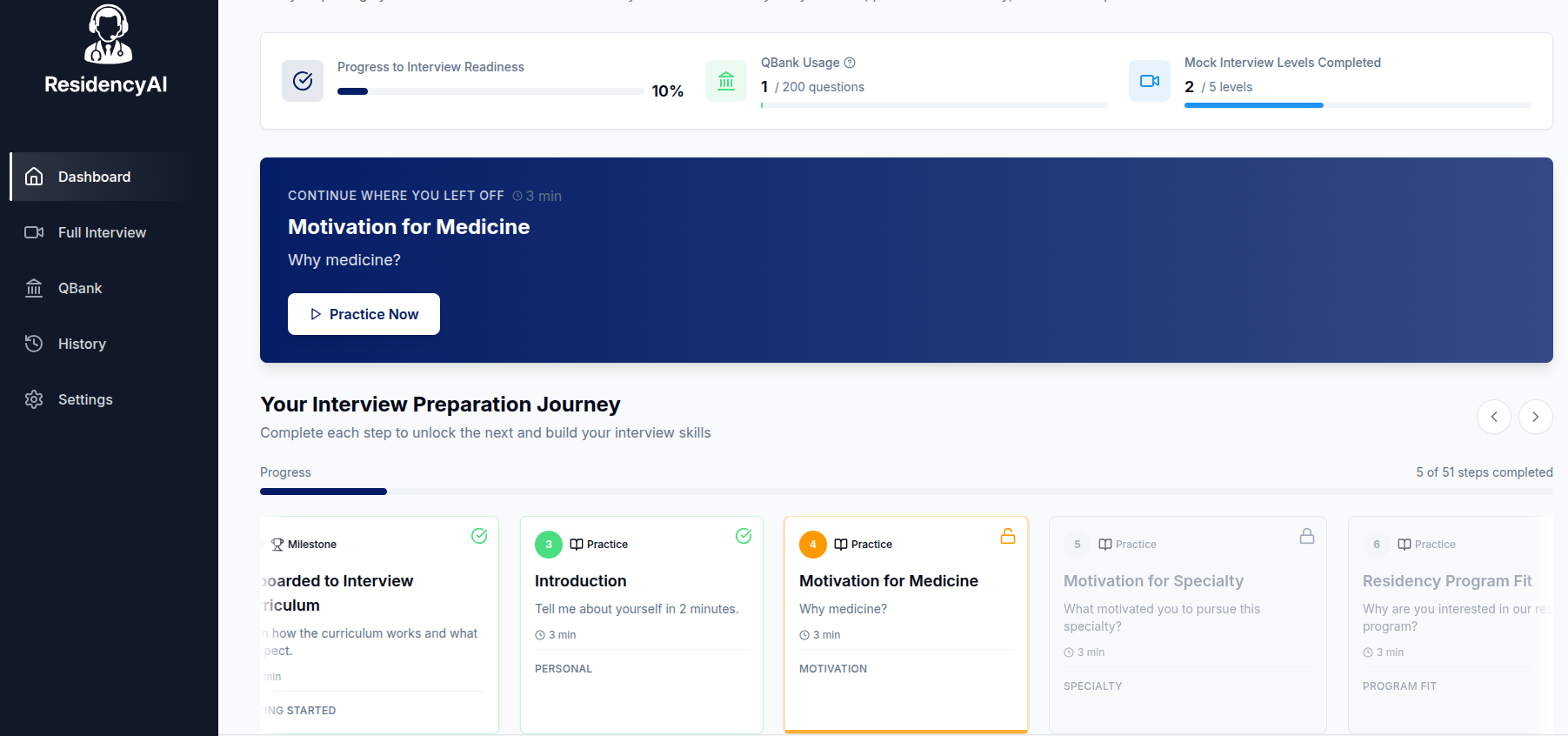
| Practice Mode | What It Looks Like | Why It Helps |
|---|---|---|
| Full Mock Interviews | Simulate a 20–30 minute session across a variety of interview scenarios. Find a quiet room and practice as if it were the real thing. | Builds stamina and confidence, and polishes your overall flow. |
| Single-Question Drills | Select any of 200+ questions from the Qbank and tackle them one at a time. | Lets you target weak spots or uncommon questions without running a full interview. |
| Personalized Questions | ResidencyAI reads your personal statement and generates interview questions tailored to your specific experiences and story. | Prepares you for the questions interviewers are most likely to ask which are specific to your application. |
Instant AI Feedback — After each answer, ResidencyAI provides personalized, detailed feedback so you know exactly what to improve.
Anytime Access — Practice at midnight or on the weekend; no need to coordinate with friends or faculty.
Why It Works
- Personalized analytics for every answer — overall feedback, strengths, areas for improvement.
- Personal statement–driven prep — your interview questions tailored to your personal statement.
- Progress tracking to monitor how ready you are ahead of your interviews.
- 24/7 availability for stress-free, on-demand practice — no scheduling, just practice whenever you want.
- Affordable price compared to other services.
Practicing with a friend or in front of the mirror can build some confidence — but ResidencyAI goes further: it reviews the personal statement that got you the interview, generates questions built specifically around it, and gives you detailed feedback on every answer. When interview day comes, you'll feel like you've been there, done that.