Top 10 CaRMS Residency Interview Questions and How to Answer Them
Table of contents
- 1. “Tell me about yourself.”
- 2. “What motivated you to pursue this specialty?”
- 3. “Why are you interested in our residency program?”
- 4. “What are your long-term career goals?”
- 5. “What are your greatest strengths?”
- 6. “Tell me about your weaknesses and how you’re improving them.”
- 7. “What do you consider the most challenging part of residency training?”
- 8. “Tell me about a time you worked in a team.”
- 9. “Tell me about a time you had to overcome a challenge.”
- 10. “Tell me about an experience that demonstrates your leadership abilities.”
- Final Thoughts
- Read Also
Residency interviews in Canada rarely surprise you. The same core questions appear year after year across Canadian programs. If you prepare thoroughly in advance, you can spend the interview building rapport rather than scrambling for answers.
This guide breaks down the 10 most common residency interview questions, explains why interviewers ask them, and shows you how to respond using proven frameworks such as:
- CAMP (Clinical · Academic · Management / Leadership · Personal)
- STAR-L (Situation · Task · Action · Result · Lesson)
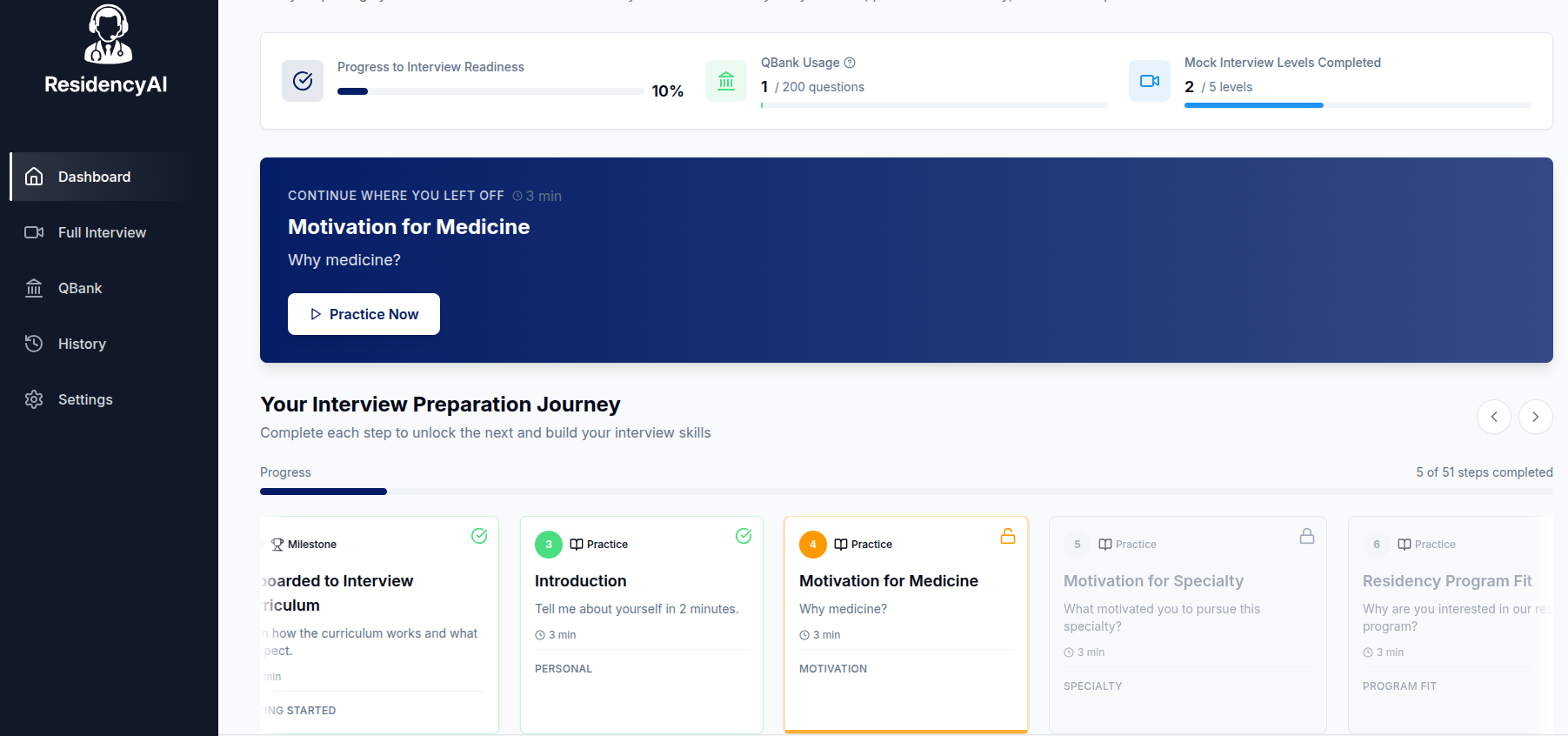
We also flag common pitfalls and suggest AI-powered mock interview tools (e.g. ResidencyAI) you can use to refine your delivery.
Canadian residency selection committees focus heavily on communication skills, professionalism, teamwork, and alignment with the Canadian healthcare system, so preparing thoughtful answers is critical.
For a broader overview of formats and timelines, read our CaRMS interview guide. You should also be ready to discuss the experiences included in your CaRMS personal letter.
1. “Tell me about yourself.”
Why interviewers ask
- Ice-breaker: It sets the tone and allows them to observe how you structure information without prompts.
- Career narrative: They want to understand your journey into medicine and the experiences that shaped your career direction.
- First impression: Your answer frames the entire interview.
How to craft a strong answer
Aim for 60–90 seconds and follow the CAMP framework:
| CAMP | What to Cover | Quick Example Snippet |
|---|---|---|
| Clinical | Where you studied medicine and key clinical experiences | "I attended XYZ Medical School, where I discovered my interest in pediatrics during my pediatric ICU rotation." |
| Academic | Research or academic work | “…I conducted research on asthma management and presented our findings at a national conference.” |
| Management / Leadership | Leadership or teamwork experiences | “…I coordinated volunteers at our student-run clinic, which strengthened my leadership and communication skills.” |
| Personal | Personal interests that show personality | “…Outside medicine, I enjoy marathon running, which helps me stay disciplined and resilient.” |
Pitfalls to avoid
- Rambling: Stick to CAMP and avoid unnecessary details.
- Reciting your CV: Focus on 2–3 defining experiences instead of listing everything.
- No personal element: Programs remember people, not resumes.
For a detailed breakdown of crafting a standout response to “Tell me about yourself,” read our step-by-step guide.
2. “What motivated you to pursue this specialty?”
Why interviewers ask
- Commitment check: Programs want to know you chose the specialty for meaningful reasons.
- Insight gauge: They want evidence that you understand the realities of the field.
- Values alignment: Your motivations should reflect the specialty’s culture and priorities.
How to craft a strong answer
| Step | What to Cover | Example Snippet |
|---|---|---|
| Moment | A defining experience that sparked your interest | “During my first NICU night shift, I helped resuscitate a premature infant and was struck by the blend of physiology and family-centered care.” |
| Pattern | Experiences that confirmed your interest | “After that rotation, I pursued further NICU electives and completed a QI project on hypothermia prevention.” |
| Future | How the specialty aligns with your strengths | “The combination of complex physiology, longitudinal care, and research-driven practice fits both my analytical mindset and long-term goals.” |
Finish by connecting the specialty to training in Canada:
“Training in Canada’s collaborative healthcare system will allow me to contribute meaningfully to patient-centered care while developing strong clinical and research skills.”
Pitfalls to avoid
- Generic answers: “I like helping people” isn’t memorable.
- Superficial reasoning: Avoid focusing solely on lifestyle.
- Negative framing: Never say you chose one specialty because you disliked another.
3. “Why are you interested in our residency program?”
Why interviewers ask
- Fit assessment: Programs want residents who align with their training philosophy and patient population.
- Preparation check: Specific answers demonstrate professionalism and preparation.
- Retention signal: Candidates who understand a program’s strengths tend to thrive there.
How to craft a strong answer
| Step | What to Cover | Example Snippet |
|---|---|---|
| Feature | A unique aspect of the program | “Your integrated HIV–hepatitis C clinic…” |
| Impact | Why the feature is important | “…provides care to a large underserved population and contributes valuable QI data.” |
| Tie-back | Connection to your experience | “…which aligns with my public-health research on viral co-infections.” |
Repeat for 2–3 program features, such as:
- Research opportunities
- Community outreach programs
- Unique patient populations
- Mentorship culture
Example closing:
“The combination of strong mentorship, community engagement, and collaborative training makes this program an ideal environment for my residency training.”
Pitfalls to avoid
- Generic praise: “Great teaching and diverse patients” applies everywhere.
- Prestige obsession: Reputation alone is not a convincing reason.
- Incorrect information: Ensure your research about the program is accurate.
4. “What are your long-term career goals?”
Why interviewers ask
- Vision check: Applicants with a clear direction tend to stay motivated.
- Program alignment: They want to know whether their training resources support your goals.
- Commitment signal: A thoughtful plan shows maturity.
How to craft a strong answer
| Step | What to Cover | Example Snippet |
|---|---|---|
| Goal | Your long-term career aim | “I aim to become an academic cardiologist focusing on heart-failure outcomes.” |
| Path | Steps to reach that goal | “During residency I plan to pursue research and develop expertise in echocardiography.” |
| Synergy | Why this program helps you achieve that | “Your program’s outcomes research group would be an excellent mentorship environment.” |
Add a broader contribution:
“I also hope to contribute to medical education and mentorship for medical students.”
Pitfalls to avoid
- No direction: Even if uncertain, discuss plausible paths.
- Program mismatch: Ensure your goals align with the program’s strengths.
- Unrealistic ambitions: Keep your goals ambitious but credible.
5. “What are your greatest strengths?”
Why interviewers ask
- Self-awareness check
- Clinical relevance: They want strengths relevant to residency.
- Evidence test: Your examples should match your evaluations and references.
How to craft a strong answer
| Step | What to Cover | Example Snippet |
|---|---|---|
| Attribute | State the strength | “One of my core strengths is adaptability.” |
| Context | Situation where it was demonstrated | “During a rural family medicine rotation, clinic volume suddenly doubled.” |
| Evidence | Result of your actions | “…I reorganized patient flow and reduced waiting times by 30%.” |
Choose 2–3 strengths and support each with evidence.
Example closing:
“Adaptability, communication, and problem-solving have helped me thrive in demanding clinical environments.”
Pitfalls to avoid
- Vague claims: Always provide evidence.
- Humble-brag clichés: Avoid “I’m a perfectionist.”
- Overconfidence: Show impact without arrogance.
6. “Tell me about your weaknesses and how you’re improving them.”
Why interviewers ask
- Self-awareness
- Growth mindset
- Risk assessment
How to craft a strong answer
| Step | What to Cover | Example Snippet |
|---|---|---|
| Acknowledge | State the weakness | “I sometimes hesitate when delegating tasks.” |
| Reason | Why it developed | “Early in training, I felt it was faster to complete tasks myself.” |
| Correction | How you improved | “I started using structured task lists and seeking feedback from senior residents.” |
Close with forward momentum:
“I continue to work on this by actively requesting feedback during team-based clinical work.”
Pitfalls to avoid
- Non-answers such as “I work too hard”
- Core competency weaknesses
- No improvement strategy
7. “What do you consider the most challenging part of residency training?”
Why interviewers ask
- Reality awareness
- Resilience assessment
- Stress-management skills
How to craft a strong answer
| Step | What to Cover | Example Snippet |
|---|---|---|
| Recognize | Identify the challenge | “One of the biggest challenges will likely be managing fatigue during demanding rotations.” |
| Analyze | Explain why it is difficult | “Clinical responsibilities increase significantly while learning remains intensive.” |
| Cope | Strategies you use | “I maintain a structured routine including regular exercise and peer debriefing.” |
| Evolve | Commitment to improvement | “I plan to continue refining these strategies during residency.” |
Example conclusion:
“Residency is demanding, but maintaining structured habits and strong peer support helps sustain performance.”
Pitfalls to avoid
- Saying nothing will be difficult
- Excessive pessimism
- Generic statements without concrete coping strategies
8. “Tell me about a time you worked in a team.”
Why interviewers ask
- Teamwork is essential in healthcare
- Past behavior predicts future collaboration
- Communication style assessment
How to answer using STAR-L
| STAR-L | What to Cover | Example |
|---|---|---|
| Situation | Context | “During my third year, I joined a quality improvement project to reduce emergency department wait times.” |
| Task | Your role | “My responsibility was analyzing patient flow data.” |
| Action | What you did | “I analyzed six months of data and presented findings to the team.” |
| Result | Outcome | “Our changes reduced average wait times by 20%.” |
| Lesson | Takeaway | “I learned how effective communication and shared goals drive successful teamwork.” |
For a comprehensive guide to behavioral questions using the STAR-L framework, read our behavioral interview guide.
9. “Tell me about a time you had to overcome a challenge.”
Why interviewers ask
- Resilience assessment
- Problem-solving ability
How to craft a strong answer
| Step | What to Cover | Example |
|---|---|---|
| Situation | Context | “During my first clinical year I struggled with balancing rotations and studying.” |
| Task | What needed improvement | “I performed poorly on my first shelf exam.” |
| Action | What you did | “I worked with a mentor to restructure my study schedule.” |
| Result | Outcome | “My exam scores improved significantly over the next rotations.” |
| Lesson | What you learned | “I learned the importance of planning and asking for help early.” |
Pitfalls to avoid
- Claiming you’ve never struggled
- Stories without resolution
- Passive storytelling
10. “Tell me about an experience that demonstrates your leadership abilities.”
Why interviewers ask
- Leadership potential
- Emotional intelligence
- Impact on teams
How to craft a strong answer
Use STAR-L:
| Step | What to Cover | Example |
|---|---|---|
| Situation | Leadership role | “During my research year I led a team of medical students working on an oncology project.” |
| Task | Goal | “Our goal was to complete experiments for a national conference submission.” |
| Action | Leadership actions | “I organized timelines, delegated tasks, and coordinated troubleshooting sessions.” |
| Result | Outcome | “We completed the project and our poster won a student award.” |
| Lesson | Leadership insight | “I learned that clear communication and empowering team members are key to effective leadership.” |
Pitfalls to avoid
- Claiming no leadership experience
- Listing titles without actions
- Blaming teammates
Final Thoughts
Practice is essential. Once your answers feel natural, focus on authentic conversation and connection during interviews.
You can use ResidencyAI to simulate mock interview sessions and practice individual questions. The platform provides AI-generated feedback on structure, clarity, and communication, helping you refine your responses before interview day.
Ready to practice your interview skills?
Try AI-powered mock interviews and get instant, actionable feedback.