How to Write a Residency Personal Statement: ERAS Guide
Table of contents
- What program directors are actually looking for
- When to start writing
- A structure that works
- Choosing your central theme
- Common mistakes that get you skimmed
- Addressing red flags: gaps and failed Step attempts
- Specialty-specific considerations
- Length, formatting, and MyERAS mechanics
- How to get feedback that actually improves your draft
- FAQ
- Practice With ResidencyAI
- Why It Works
- Read Also
If you're staring at a blank page somewhere between July and September, trying to compress four years of medical school into one page, here's the simplest way to think about it: your ERAS personal statement isn't a creative writing exercise. It's a screening tool. Program directors read it quickly, and with three questions in mind: do you understand this specialty, would they want you on their team during a hard night on call, and does your story match the rest of your application. This guide walks MS4s and international medical graduates (IMGs) through what actually matters: structure, length, red flags, specialty differences, and MyERAS submission rules. It also covers something almost no other guide mentions: how a well-written statement becomes your best tool for interview preparation.
What program directors are actually looking for
Here's why this matters. The 2026 Main Residency Match was the largest in history, with 53,373 registered applicants and 44,344 positions offered. Program directors have thousands of files to review, and the 2024 NRMP Program Director Survey shows how much weight the personal statement carries compared to everything else in your file:
- Passing USMLE Step 1 — cited by 90% of program directors as an interview-selection factor
- MSPE/Dean's Letter — 85%
- Specialty-specific letters of recommendation — 84%
The personal statement doesn't crack the NRMP's own top-three list for interview selection. That doesn't mean it's ignored, program directors do read it, but it tells you where to set your expectations. A weak personal statement probably won't sink a strong application by itself. A strong one usually can't save a weak application either. It's one piece of a bigger picture, and its main job is to not work against you.
There's a second reason the essay matters more than these numbers suggest. USMLE Step 1 is now pass/fail, so program directors rely more on things a test score can't show them: communication, professionalism, judgment. The AAFP says your statement should show "reflection, professionalism and communication skills." Those same qualities matter later too. Once programs sit down to rank applicants, interpersonal skills (89%) and how you came across in your interview (87%) are the top two factors.
Your personal statement's real job is to make a busy reader think: I understand how this person will act when things get hard on call. Not: this person did a lot of things in medical school.
When to start writing
Start earlier than you think you need to. MedSchoolCoach recommends beginning your draft six to eight weeks before you plan to submit. The 2027 cycle dates support this:
- June 4, 2026 — the 2027 ERAS season begins
- September 2, 2026 — applicants can begin submitting to programs
- September 23, 2026 — programs begin reviewing applications
The last date is the one that really matters, because most programs start reviewing applications and offering interviews as soon as they come in. So work backward from it: brainstorm in June, write a first draft in July, and revise through August. That gives you three or four rounds of edits before the busiest part of application season starts. (For the full month-by-month schedule, see Match 2027 residency interview guide.)
One habit to start now: write your draft in a plain text document, not inside MyERAS itself. That way you won't accidentally submit an unfinished version, and it's easier to share your draft with someone for feedback.
A structure that works
This isn't like writing a patient note. It's persuasive writing, and a simple structure works best:
- Opening (1 paragraph): Start with a specific moment or detail that pulls the reader in and hints at your specialty choice. Don't open with "I have always wanted to be a doctor." Keep this part short, just a sentence or two.
- Body (2–3 paragraphs): Each paragraph should focus on one experience and go deep on it. The AAFP recommends a simple pattern for each: what was the challenge, what did you do, what happened as a result.
- Closing (1 paragraph): Return to the moment or idea from your opening, then look ahead to the kind of resident and physician you're becoming.
| Element | Weak version | Strong version |
|---|---|---|
| Opening | "Ever since I was a child, I have wanted to help people." | A concrete 2–3 sentence scene only you could have written |
| Body paragraphs | A list of every rotation and activity, in order | Two or three experiences, each explained in terms of what it taught you |
| Evidence | "I am compassionate and hard-working." | A moment that shows the trait in action |
| Specialty fit | "I love the variety of internal medicine." | A specific reason: the kind of reasoning, continuity, or pace that fits you |
| Closing | "I would be honored to train at your program." | An image or idea that connects back to the opening |
Fewer experiences, told well, work better than many experiences told quickly. Five experiences squeezed into 800 words will blur together. Two experiences, explored properly, will tell the reader who you are.
Choosing your central theme
The strongest statements have one clear idea that every paragraph supports: why this specialty, specifically, for you. Sanjay Desai, MD, the AMA's chief academic officer and a former internal medicine program director, offers a simple test: if you could copy a paragraph and paste it into someone else's personal statement, and it would still make sense, it isn't personal enough.
To find your own central idea, try filling in this sentence from the AAFP: "Because of ___, I want to spend my career doing ___ for ___ patients in ___ settings." Once you've answered that honestly, you have the basic idea for your essay. Then choose the one or two experiences that best support it. Anything else can go in your ERAS Impactful Experiences entries instead.
Common mistakes that get you skimmed
Certain patterns make an experienced reader lose interest right away, because they've seen the same thing many times before. Avoid:
- The generic altruism opening — "I love medicine because I love helping people" is the line program directors are most tired of reading.
- The essay that just repeats your CV — programs already have your ERAS data and publication list. Explain what your experiences meant, don't just list them again.
- The origin story — spending a full paragraph on your childhood or the moment you decided to become a doctor doesn't help a program decide whether they want you as an intern.
- The story with no lesson attached — a vivid story falls flat if you never say what it taught you.
- Negativity — criticizing other specialties, people, or systems reads as a warning sign about how you'll behave on a team.
- Typos and rambling — this document is supposed to prove you communicate well, so careless errors stand out more here than they would elsewhere.
Addressing red flags: gaps and failed Step attempts
If you have a red flag on your record, a failed Step attempt, a training gap, a leave of absence, assume programs will already see it in your MSPE, transcript, or score report before they read your essay. ECFMG's guidance is clear: be honest about it, because "this is your chance to explain it." Staying silent usually looks worse than the red flag itself. It leaves reviewers wondering whether you don't realize it's a problem, whether you're trying to hide it, or whether you haven't actually grown from it.
Three rules for handling it well:
- Be brief. A sentence or two, or a short paragraph. The red flag is one part of your story, not the whole thing.
- Take responsibility, then explain what changed. The AAFP recommends naming the issue plainly, without excuses, explaining what you did about it, and showing proof things improved: a higher score, stronger evaluations, whatever applies to you.
- Don't open with it. Starting your essay with "I failed Step 1" makes it sound like the most important thing about you. If you have more than one issue to address, consider a short note placed after the end of your personal statement instead, so the essay itself stays focused on who you are.
Specialty-specific considerations
You don't need a separate essay for every program, but the tone and focus should shift depending on your specialty. The length should stay about the same either way, roughly one page, while the content shows programs that you understand the field.
| Specialty | What to emphasize | Watch out for |
|---|---|---|
| Internal Medicine | Diagnostic reasoning, breadth, long-term patient relationships | Writing an essay that sounds like it's for a cardiology fellowship — anchor it in IM first |
| General Surgery | Teamwork in the OR, resilience, technical drive; keep it tight | Openings that are too long or too poetic |
| Family Medicine | Continuity of care, scope of practice, community health | Vague lines like "I love variety" |
| Psychiatry | Communication, empathy, the therapeutic relationship | A tone that's too clinical or detached |
For IMGs, the essay can carry more context because program reviewers may be less familiar with your home institution and training path. The gap in outcomes is real: according to NRMP's 2026 Match results, the PGY-1 match rate was 93.5% for U.S. MD seniors and 70% for U.S.-citizen IMGs.
What helps:
- Explaining clearly why you want to train in the U.S.
- Highlighting U.S. clinical experience (USCE), if you have it
- Keeping your language clear and direct, not overly formal
What doesn't help: repeating credentials, scores, visa status, USCE hours, that ECFMG already sends to programs separately. This is the most common mistake IMG applicants make.
Length, formatting, and MyERAS mechanics
MyERAS allows up to 28,000 characters, including spaces and punctuation. Treat that as a technical maximum, not a writing target. A practical target is about one page, often roughly 650 to 850 words, unless your advisor or specialty gives you different guidance.
A few small mistakes that can quietly cost you interviews:
- Write in plain text. Documents built in Word "may contain hidden and potentially invalid formatting" that breaks when pasted into MyERAS, according to the AAMC.
- Use the preview. MyERAS shows your statement exactly as programs will see it, including the page count. Always check it before submitting.
- Don't count on last-minute fixes. You can create multiple statements and assign one per program, but programs aren't guaranteed to re-read an updated version.
- Never plagiarize. The AAMC investigates suspected plagiarism, and a confirmed case can follow you into future Match seasons.
- AI use is allowed, within limits. According to the AAMC, using AI to brainstorm, proofread, or edit your personal statement is fine, but the final version needs to represent your own work.
How to get feedback that actually improves your draft
Most applicants get the wrong kind of feedback. Either a mentor tells them it "looks great," or an editing service rewrites the essay until it no longer sounds like them. Neither one actually helps. What helps is specific feedback: is your story specific enough, does each paragraph earn its place, would a stranger finish reading and understand who you'll be as a resident? Read your draft out loud. Give it to someone who knows you well. And check it against the Desai test: could this paragraph belong to someone else?
There's one more thing almost no other guide mentions: your personal statement doubles as interview preparation. Interviewers often build their questions directly from what you wrote. A common prompt is why did you include this detail in your application?, so expect to explain, out loud, every experience and reason you put in your essay.
That's exactly what ResidencyAI is built for. ResidencyAI's reviewer gives you specific feedback on your draft, then creates personalized mock interview questions based on that same statement. The essay you spend all summer writing becomes the material you practice with in the fall.
FAQ
How long should a residency personal statement be? About one page, roughly 650–850 words. The 28,000-character MyERAS limit is a technical maximum, not a goal.
One statement per specialty or per program? One main statement per specialty is standard. You can adjust the closing paragraph for top-choice programs, but only if the change says something real, a generic line like "I'd love to train here" is a red flag program directors notice.
Can I reuse my medical school personal statement? No. Use it only to reflect on how far you've come. Residency programs want to see growth and a specific, deeper commitment to your chosen specialty, not the story you told as a premed.
Is it ethical to use AI? The AAMC allows AI for brainstorming, proofreading, and editing, but the final statement must represent your own work and accurately reflect your experiences. Use feedback to strengthen your writing, not replace your voice.
Do program directors even read it? Yes, usually quickly and selectively, often after they've already looked at your scores and letters. It rarely earns you an interview by itself, but a weak one can hurt an otherwise strong application.
Practice With ResidencyAI
Writing a personal statement by yourself can be very daunting. ResidencyAI can review your personal statement, annotate it and suggest changes that will distinguish it from the crowd. Additionally, ResidencyAI will act as your personal interview coach, available, to help you practice and refine your answers.
Ready to practice your interview skills?
Try AI-powered mock interviews and get instant, actionable feedback.
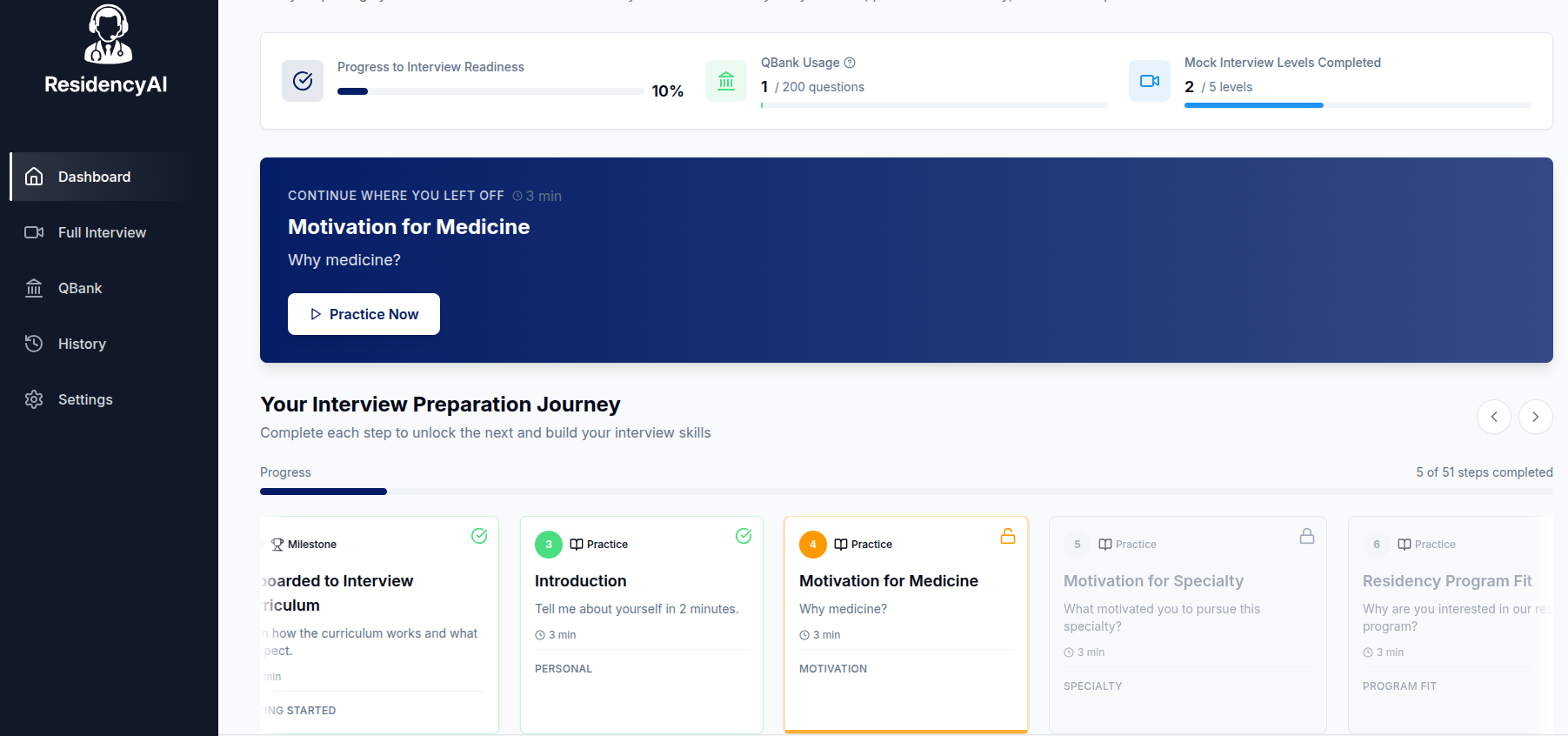
| Practice Mode | What It Looks Like | Why It Helps |
|---|---|---|
| Full Mock Interviews | Simulate a 20–30 minute session across a variety of interview scenarios. Find a quiet room and practice as if it were the real thing. | Builds stamina and confidence, and polishes your overall flow. |
| Single-Question Drills | Select any of 200+ questions from the Qbank and tackle them one at a time. | Lets you target weak spots or uncommon questions without running a full interview. |
| Personalized Questions | ResidencyAI reads your personal statement and generates interview questions tailored to your specific experiences and story. | Prepares you for the questions interviewers are most likely to ask which are specific to your application. |
Instant AI Feedback — After each answer, ResidencyAI provides personalized, detailed feedback so you know exactly what to improve.
Anytime Access — Practice at midnight or on the weekend; no need to coordinate with friends or faculty.
Why It Works
- Personalized analytics for every answer — overall feedback, strengths, areas for improvement.
- Personal statement–driven prep — your interview questions tailored to your personal statement.
- Progress tracking to monitor how ready you are ahead of your interviews.
- 24/7 availability for stress-free, on-demand practice — no scheduling, just practice whenever you want.
- Affordable price compared to other services.
Practicing with a friend or in front of the mirror can build some confidence — but ResidencyAI goes further: it reviews the personal statement that got you the interview, generates questions built specifically around it, and gives you detailed feedback on every answer. When interview day comes, you'll feel like you've been there, done that.