The Complete Match 2027 Residency Interview Preparation Guide
Table of contents
Introduction: Why Residency Interviews Matter
After months of perfecting your ERAS application, collecting Letters of Recommendations, and nailing exams, the interview is where programs assess whether you’re the right fit—and where you decide if they meet your goals. Program directors consistently cite the interview as the deciding factor when ranking applicants. Every interaction counts: emails, conversations with coordinators, and your on-screen or in-person presence all shape first impressions.
Remember, interviews are a two-way street. As the AAMC emphasizes, while programs evaluate you, you must also gauge each program’s culture, values, and training style. Thorough residency interview preparation lets you showcase your strengths and critically assess each program. In this residency interview preparation guide, you’ll find:
- A concise overview of the ERAS timeline
- Strategic pre-interview prep steps
- In-Depth Program Research
- Self-Assessment and Knowing Your Application Inside-Out
- Creating Your Personalized Interview Study Guide
- Mock Interviews and Practice: The Power of Preparation
- Tips on using ResidencyAI for cutting-edge residency interview prep
Approach the process methodically and you’ll maximize your chances of matching in 2027.
ERAS & Match Timeline: Where Interviews Fit
Quick view: ERAS opens June 4, 2026 → Applications submit September 2, 2026 → Programs review applications September 23, 2026 → Rank lists are due March 3, 2027 → Match Day is March 19, 2027
Key Milestones
| Date | Milestone | What to do? |
|---|---|---|
| June 4, 2026 | 2027 ERAS season begins | Start personal statement, CV, and LoRs |
| September 2, 2026 | Applicants may submit MyERAS applications | Double-check all documents before submitting |
| September 23, 2026 | Programs may begin reviewing applications | Be ready for interview invitations |
| Oct 2026 – Jan 2027 | Interview season | Track invites, prep responses |
| March 3, 2027 | Rank Order List certification deadline | Finalize and certify program preferences |
| March 19, 2027 | Match Day | Review your result and plan next steps |
Interview invitations arrive in waves, mainly October-November, though some programs fill last-minute slots into January.
Virtual vs. in-person: Since 2020 many programs favor virtual platforms. Treat video interviews with the same professionalism - test your tech, ensure a distraction-free setting, and maintain eye contact via camera.
Why the Interview Is Make-or-Break
- Programs’ perspective: Determines rank placement on their list.
- Your perspective: Clarifies training quality, mentorship, and culture so you can rank wisely.
- Outcome: A confident interview trail translates into a confident Rank Order List.
Strategic Pre-Interview Preparation Steps
Effective residency interview preparation begins before the first invite hits your inbox. By tackling four pillars—Program Research, Self-Assessment & Application Review, Personalized Interview Study Guide, and Mock Interview Practice—you’ll arrive at every interview poised and confident.
Preparation Roadmap 1️⃣ Program Research → 2️⃣ Self-Assessment & Application Review → 3️⃣ Personalized Interview Study Guide → 4️⃣ Mock Interviews (e.g. with ResidencyAI) → Interview-Day Success
1. In-Depth Program Research
Residency programs expect more than a superficial understanding of their training environment. As the AMA advises, you should “thoroughly research each residency program before your interview.” Go beyond the homepage and dive into curriculum specifics, faculty interests, and resident culture.
| Focus Area | Guiding Questions |
|---|---|
| Curriculum & Rotations | How are rotations structured? Are there specialized tracks (research, global health, clinician-educator)? |
| Program Strengths | What differentiates this program (e.g., case volume, community outreach, fellowship placement)? |
| Mission & Values | Do their priorities align with your goals? |
| Specialty Trends | What attributes is your specialty seeking? How do your experiences address them? |
| Outcomes & Data | Board-pass rates, fellowship matches, research output. |
Gather Insider Insights
- Current Residents & Alumni: Leverage school networks or virtual meet-and-greets to learn about morale, workload, and mentorship.
- Faculty Mentors: Ask about program reputation and evolving curriculum highlights.
- Program News: Track recent grants, leadership changes, or hospital expansions.
Why Deep Research Pays Off
- Tailored Answers: When asked “Why our program?” you’ll cite specifics—“Your clinician-educator track aligns perfectly with my teaching focus.”
- Thoughtful Questions: Rather than rehashing website basics, dig into nuanced topics—“How has the new curriculum affected night-float autonomy?”
- Professional Impression: Demonstrates diligence and genuine interest.
Pro Tip: Create a one-page Program Snapshot for each interview. Include the mission statement, standout strengths, key faculty, and at least three personalized questions. Review it the night before and moments before the interview to keep details fresh.
2. Self-Assessment: Know Your Application Inside-Out
Program research is vital, but mastering your own story is non-negotiable. Interviewers will mine your ERAS for talking points—be ready to expand on any line with depth and insight.
Step-by-Step Self-Audit
-
Review Every Entry
- Personal statement, clinical experiences, research, leadership, hobbies—nothing is off-limits.
- For each item, prepare a brief story: what you did, what you learned, and why it matters.
-
Add Layers Beyond the CV The AAMC advises: “If asked about an experience, don’t repeat your application—add depth.”
- Swap bullet points for anecdotes (e.g., a challenge you solved during a research project).
- Highlight growth: how the experience shaped your skills or values.
-
Map Your Core Attributes
Category Examples Prep Tip Strengths Teamwork, resilience, empathy Pair each with a concrete story. Weaknesses Over-planning, limited procedural exposure Show active improvement. Key Qualities Leadership, adaptability, cultural humility Link to residency-relevant scenarios. -
Anticipate Tough Questions
- Red flags: gaps, low scores, career pivots—craft concise, honest explanations focused on growth.
- IMG or specialty switch? Have a clear narrative for your journey and motivation.
-
Practice Out Loud
- Conduct mock sessions with peers, mentors, or ResidencyAI to refine delivery.
- Record yourself to spot rambling or missing details.
Bottom line: You are the undisputed expert on you. Thorough self-assessment ensures that when an interviewer asks, you respond with clarity, confidence, and compelling stories.
3. Build Your Personalized Interview Study Guide
A tailored interview study guide turns scattered preparation into a single, high-impact playbook you can refine over time. Here’s how to assemble one.
| Section | What to Include | Why It Matters |
|---|---|---|
| Core Questions & Outlines | Bullet points—not scripts—for staples like: • "Tell me about yourself." • “Why this specialty?” • “Why our program?” • Strengths / weaknesses • Conflict / failure scenarios | Keeps answers natural yet organized under pressure. |
| Stories & Examples | 5–7 versatile anecdotes mapped to qualities (leadership, resilience, empathy). Draft in STAR-L format (Situation-Task-Action-Result-Lessons Learned) for quick recall. | One story can be used to answer multiple questions. |
| Program-Specific Notes | For each interview: • Unique strengths you admire • Mutual connections or faculty to mention • 2–3 thoughtful questions (curriculum changes, resident wellness, mentorship) | Demonstrates genuine interest and drives deeper conversation. |
| Personal Pitch | 2–3 key messages you want every program to remember—your “mission statement.” | Reinforces your brand across all answers. |
| Logistics Checklist | • Confirm date/time zone • Test tech (virtual) • Prep attire & background • Travel/parking plan (in-person) | Eliminates avoidable day-of stress. |
Pro Tip: Refine your answers using the detailed personalised feedback provided by ResidencyAI. Continuous iteration sharpens weak spots and keeps details fresh.
A concise guide helps you strike that balance—structured enough to prevent blanks, flexible enough to sound authentic. Review it the night before and moments before each interview, and you’ll step in organized, confident, and ready for any question.
4. Mock Interviews: Rehearse Like It’s Game Day
Practice transforms anxiety into confidence. Both the AAMC and AMA underline mock interviews as essential preparation—just like question banks for USMLEs and Board exams.
Set the Stage
| Mode | Replicate This | Why It Helps |
|---|---|---|
| Virtual | Zoom or your program’s platform, professional attire, quiet well-lit space, webcam-level eye contact | Builds comfort with tech delays, lighting, and camera presence |
| In-Person | Full suit, firm handshake, seated posture | Fine-tunes non-verbals and physical poise |
Pro Tip: Record your session. Playback flags issues—wandering gaze, filler words, fidgeting—that live feedback can miss.
Drill the Core Questions
-
- “Tell me about yourself.”
- “Why this specialty/program?”
- Strengths & weaknesses Nail these until they’re concise (≈2 minutes) and authentic.
-
- “Tell me about a time you led under pressure.”
- “How would you handle an ethical dilemma on night float?” Use the STAR-L framework (Situation → Task → Action → Result → Lessons Learned) to keep answers focused.
-
Follow-Up Depth Have your mock interviewer push for specifics: “What was your exact role?” This trains you to deliver detail without rambling.
Practice With ResidencyAI
Staring at 200+ questions can feel overwhelming, but consistent, feedback-driven practice turns quantity into confidence. ResidencyAI will act as your personal interview coach, available, to help you practice and refine your answers.
Ready to practice your interview skills?
Try AI-powered mock interviews and get instant, actionable feedback.
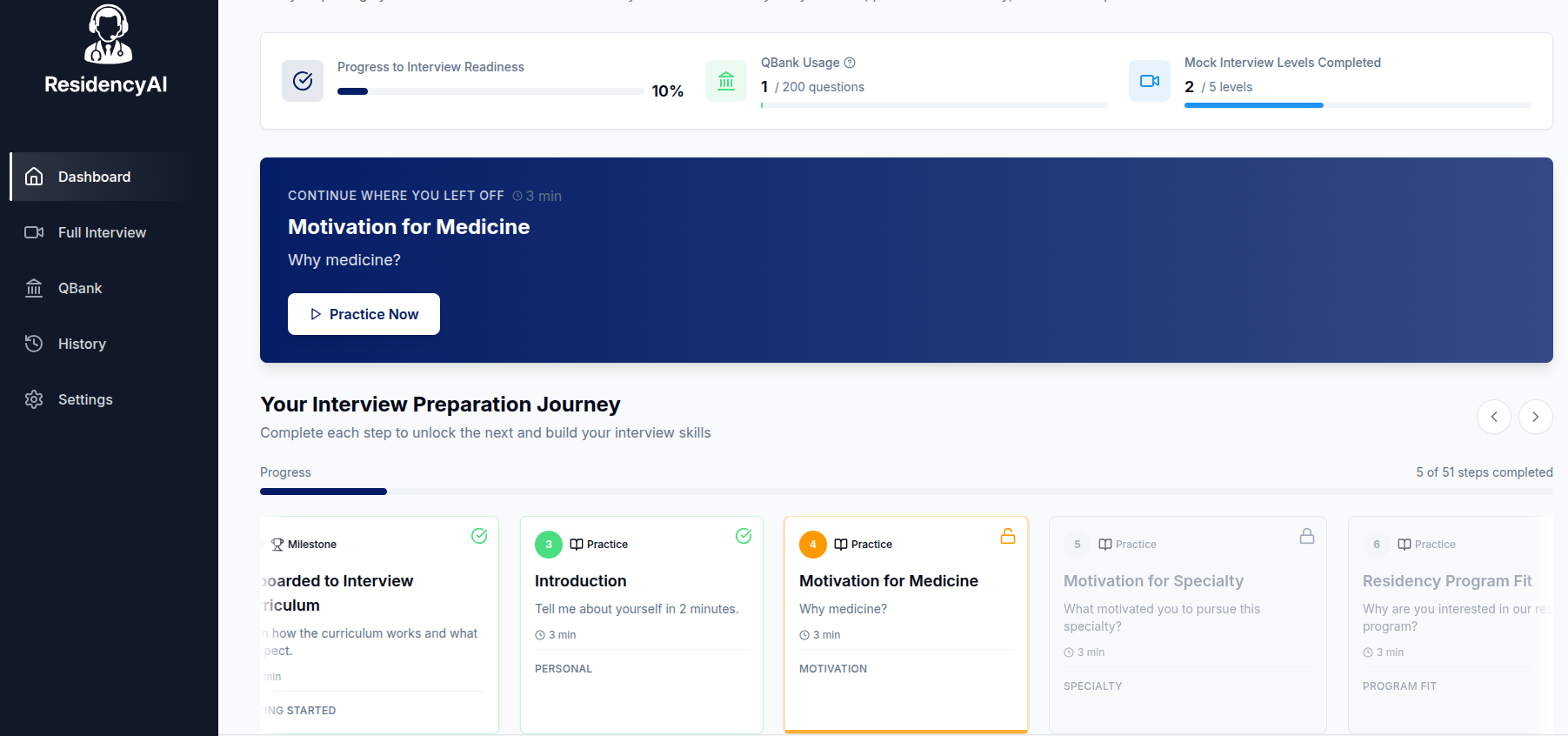
| Practice Mode | What It Looks Like | Why It Helps |
|---|---|---|
| Full Mock Interviews | Simulate a 20–30 minute session across a variety of interview scenarios. Find a quiet room and practice as if it were the real thing. | Builds stamina and confidence, and polishes your overall flow. |
| Single-Question Drills | Select any of 200+ questions from the Qbank and tackle them one at a time. | Lets you target weak spots or uncommon questions without running a full interview. |
| Personalized Questions | ResidencyAI reads your personal statement and generates interview questions tailored to your specific experiences and story. | Prepares you for the questions interviewers are most likely to ask which are specific to your application. |
Instant AI Feedback — After each answer, ResidencyAI provides personalized, detailed feedback so you know exactly what to improve.
Personal Statement Review — Beyond interviews, ResidencyAI reviews your personal statement, annotates it, and provides concrete ways to polish it.
Anytime Access — Practice at midnight or on the weekend; no need to coordinate with friends or faculty.
Why It Works
- Personalized analytics for every answer — overall feedback, strengths, areas for improvement.
- Personal statement–driven prep — your interview questions tailored to your personal statement.
- Progress tracking to monitor how ready you are ahead of your interviews.
- 24/7 availability for stress-free, on-demand practice — no scheduling, just practice whenever you want.
- Affordable price compared to other services.
Practicing with a friend or in front of the mirror can build some confidence — but ResidencyAI goes further: it reviews the personal statement that got you the interview, generates questions built specifically around it, and gives you detailed feedback on every answer. When interview day comes, you'll feel like you've been there, done that.